
5-gallon pails
Often suitable for trials and smaller manufacturing runs; exact net weight varies with product density and concentration.
Bulk rhubarb juice concentrate for industrial manufacturers seeking pronounced tartness, distinctive rhubarb flavor and concentrated soluble solids in an efficient liquid format. PFVN supports specification-based sourcing for beverage, fruit-preparation, flavor-system, confectionery, bakery and fruit-snack programs.
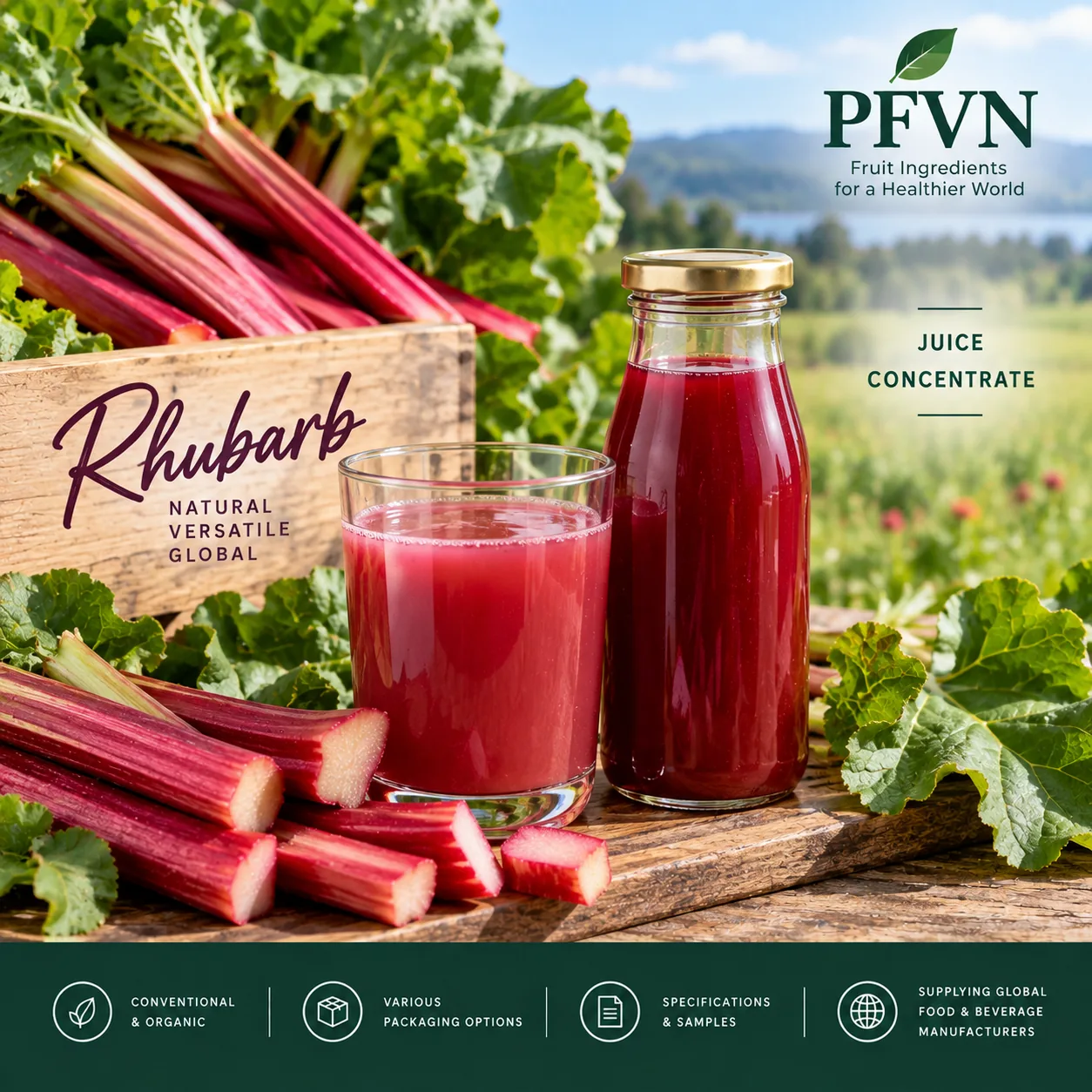
Rhubarb is a perennial plant cultivated for its edible stalks, or petioles. Although commonly used alongside fruits in desserts, jams and beverages, rhubarb is botanically a vegetable. Commercial stalks can range from green and pale pink to deep red depending on cultivar, maturity and growing conditions.
Its most recognizable characteristic is pronounced natural tartness combined with a light vegetal-fruity aroma. Unlike naturally sweet fruit juices, rhubarb generally requires balancing with sugar, fruit juice or other sweet components in finished foods and beverages.
Processing rhubarb into juice concentrate creates a more compact liquid ingredient in which acidity, soluble solids and characteristic flavor are concentrated relative to single-strength juice. Color and flavor intensity can vary significantly between green-stalk and red-stalk raw material and between processing methods.
Commercial qualification should focus on the properties that determine acid contribution, flavor intensity, appearance and processing consistency.
Confirm the supplied concentrate's °Brix or soluble-solids range when applicable because concentration affects inclusion rate and formulation calculations.
Acidity is one of rhubarb concentrate's most important formulation characteristics. Titratable acidity can be especially useful when comparing lots or sources for equivalent tartness contribution.
Commercial material may vary from pale green-yellow or amber to pink-red tones according to stalk variety, extraction and processing. Define a target where color is important.
Specify clarified or cloudy style according to the intended beverage, filling or flavor system. Suspended material can affect appearance and sediment.
Approve representative material for characteristic rhubarb tartness and stalk-like fruit character, with limits for excessive fermented, oxidized or cooked notes.
Concentration and temperature can affect flow, pumping and metering. Confirm handling characteristics for the intended plant equipment.
Set microbiological requirements appropriate to the supplied concentrate, storage format and validated manufacturing process.
Where color or acidity is critical, sourcing programs may need tighter control of cultivar, origin or accepted sensory range.
Rhubarb concentrate is particularly useful when a formulation needs a recognizable tart profile rather than additional sweetness. Its acidity can help sharpen sweeter fruit systems and create more complex flavor in beverages, preserves, confectionery and bakery fillings.
Classic pairings include strawberry and other berries, apple, pear and selected citrus flavors. In these combinations, rhubarb can reduce perceived sweetness and add a fresh, tangy dimension without overwhelming the primary fruit when used at an appropriate level.
Rhubarb concentrate is most valuable in formulations where tartness, recognizable rhubarb character and controlled liquid dosing are required.
Used in rhubarb drinks and blended beverages where its strong acidity can balance strawberry, apple, berry, pear or citrus profiles.
Application guide → Beverages Functional & Botanical BeveragesRhubarb concentrate can provide a naturally tart flavor foundation for wellness-style, botanical and specialty beverage concepts.
Application guide → Flavor systems Fruit Bases, Syrups & CompoundsIts concentrated tart profile makes it useful in beverage bases, syrups and compounded fruit systems designed to add acidic fruit complexity.
Application guide → Confectionery Gummies, Jellies & Fruit CandyRhubarb concentrate can provide tart fruit character in gummies, jellies, chews and sour confectionery, usually balanced with sweeter fruit components.
Application guide → Bakery Pie, Pastry & Bakery FillingsParticularly suited to strawberry-rhubarb and other fruit fillings where controlled acidity and characteristic rhubarb flavor are desired.
Application guide → Snacks Fruit Snacks & Blended Fruit SystemsCan provide tartness and differentiation in fruit bars, bites, sheets and other high-solids blended fruit formulations.
Application guide →Rhubarb concentrate should be evaluated after the intended manufacturing process because heat, oxygen and formulation pH can alter color and soften the fresh stalk-like flavor profile. Commercial sourcing should also account for cultivar and crop differences.
Measure the rhubarb concentrate's contribution before finalizing citric, malic or other added-acid systems to avoid excessive tartness.
Extended thermal exposure can shift rhubarb from fresh, sharp notes toward a more cooked profile, which may be desirable in fillings but less so in beverages.
Red-stalk material can offer a different visual profile from green-stalk rhubarb. Specify color expectations where the ingredient affects finished appearance.
Crop timing, cultivar mix and processing availability can affect commercial supply, color consistency and lead time.
Review specification, Certificate of Analysis where applicable, ingredient declaration, microbiology, origin and required certifications.
Evaluate price together with concentration, acidity, formulation dosage, packaging, freight and storage rather than purchase price per kilogram alone.
This is currently the only listed PFVN format for this ingredient.
Select package size around batch volume, concentrate viscosity, storage condition, thawing or pumping requirements, production rate and unloading equipment.
Often suitable for trials and smaller manufacturing runs; exact net weight varies with product density and concentration.
Common frozen or aseptic bag-in-drum scale for concentrated liquid ingredients; exact fill weight and storage condition are product-specific.
Potential option for higher-throughput programs where product stability, handling characteristics and supplier capabilities support tote filling.
May be available for selected high-volume programs where transport stability, storage and unloading systems are suitable.
Include the application, target °Brix or acidity, color or clarity requirement, quantity, packaging, certifications, delivery location and timing. We’ll use those details to route your inquiry efficiently.